By Steven Hamburg and Ritesh Gautam
Low-producing oil and gas wells, often called marginal or stripper wells, rarely attract attention. Each produces little energy and, on its own, emits relatively small amounts of methane pollution. However, there are hundreds of thousands of these wells across the United States, and their collective contribution to methane pollution has remained poorly understood.
MethaneSAT's high-precision measurements are changing that.
Newly analyzed MethaneSAT data show that low-producing well sites are the largest source of methane pollution from U.S. oil and gas production, revealing a major gap in our understanding of how this legacy infrastructure contributes to total emissions.
Using MethaneSAT data from 11 U.S. oil and gas basins, EDF scientists examined an area of nearly one million square kilometers that represents more than 80% of U.S. onshore production. MethaneSAT's unique combination of high precision, high spatial resolution with wide-area coverage enabled emissions analysis from 280,000 well sites, including approximately 240,000 marginal well sites. This represents the largest measurement-based assessment to date of emissions from marginal wells.
Marginal production. Major pollution.
Available as a preprint, the analysis finds that marginal wells are a disproportionally large source of methane emissions. Although these wells each produce less than 15 barrels of oil equivalent per day and collectively account for only 5% of U.S. oil and gas output, they account for almost 60% of total production-site related methane emissions.
Their methane emissions intensity, measured as methane emitted relative to gas production or total oil and gas production, is more than 10 times higher than that of higher-producing wells. For example, methane emissions from low-producing wells were estimated at 16% of marketed gas production, compared with 0.6% for higher-producing wells. Both figures exceed the oil and gas industry’s commonly cited leading-practice benchmark of 0.2%, but low-performing wells perform especially poorly, with emissions intensity substantially higher than that benchmark.
By separating production-related emissions from those associated with other oil and gas infrastructure, the analysis provides strong evidence to date that meaningful reductions in U.S. oil and gas methane emissions will require direct action on low-producing wells.
Built to see the whole picture with detail
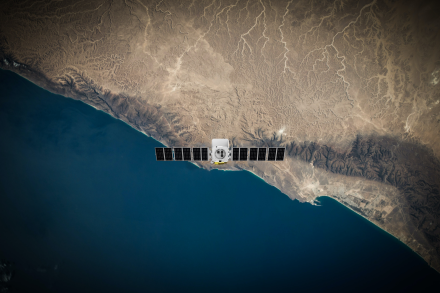
Methane-monitoring systems today have tradeoffs between coverage and source attribution. Global mapping satellites provide broad coverage but are not effective in distinguishing among individual source types. Other point source imaging satellites detect and quantify high-emitting methane plumes but miss smaller, more diffuse sources. MethaneSAT was designed to bridge this gap by combining wide-area coverage, high precision, and high spatial resolution.
Researchers used MethaneSAT’s high spatial resolution data (4 km x 4 km individual grids) to identify "production-only" areas covering a total of 300,000 square kilometers (~185,000 square miles). These areas exclude infrastructure that contributes to production-site level emissions, including processing plants, storage tanks, refineries, LNG facilities and compressor stations. By linking emissions measured within the 4 km grids to oil and gas production data, the team compared emissions from satellite-observed low- and high-producing wells and scaled the results nationally to approximately 545,000 marginal and 113,000 non-marginal wells across the United States.
The analysis suggests that 88% of observed well-site emissions came from grids emitting less than 100 kilograms of methane per hour per well site. In other words, most methane emissions from U.S. oil and gas wells originate from sources below the detection threshold of satellite technologies designed primarily to identify super emitters. While mitigating super-emitters remains critical, these findings show that any comprehensive methane reduction strategy must also address low-producing wells, which account for more than half of the total production-site level methane emissions and approximately 40% of methane emissions across the U.S. oil and gas supply chain.
Addressing emissions from low-producing wells is essential for achieving meaningful reductions in methane intensity. MethaneSAT's measurements enable basin-level quantification of oil and gas emissions while also attributing emissions to specific production areas, helping identify where progress is occuring and where additional action is needed.
A comprehensive basin-scale milestone for emissions validation and action
The findings echo what other efforts using different measurement approaches have found at the basin level. A 2024 LiDAR-based emissions inventory in the Permian Basin found that low-producing wells accounted for 35% of total well-site methane emissions. The MethaneSAT analysis produced a similar estimate of 33% from the Permian. In Appalachia, MethaneSAT data revealed that low-producing wells were responsible for approximately 70% of the production-related methane emissions, closely aligning with a recent Appalachian Methane Initiative report estimate of 78% from conventional wells that are predominantly low-producing.
The latest insights are specific to the United States; comparable well-site production data is not publicly available across the globe. With broader access to industry data, similar granular analyses could be conducted in other countries and basins.
By combining regional measurements with source-level detail, this analysis demonstrates a new satellite-based approach for quantifying methane emissions within and across oil and gas regions. The approach enables more detailed and spatially resolved assessments of emissions sources than previously possible.
MethaneSAT gives policymakers, regulators, researchers and industry leaders a detailed baseline for finding the highest-impact solutions and tracking progress. By revealing the outsized role of marginal wells, these findings point to one of the clearest opportunities to reduce methane emissions, cut waste, and improve the performance of oil and gas operations.